How to plan a travel film to music before you shoot
Pick the song before you pack, cut it into sections, and work out how many shots each one needs. A simple way to come home with the film instead of four days of footage.
I spent four days in Luxembourg City with a camera and a song. The song was On Top of the World, by Imagine Dragons; I had chosen it before the trip, the way I always do, so I could walk around with it in my head and notice what fit and what didn't.
What I didn't have was anything else. No idea of what the intro needed, or how many shots the chorus would eat, or what I was supposed to be doing at sunset on day two. So I filmed everything. I came home with far more footage than I needed and used a small fraction of it — and none of it had been shot for any particular part of the song. I was fitting clips to the music afterwards instead of collecting what the music asked for. Worse, back home I couldn't tell what I had actually shot and what I hadn't: the only way to find out was to watch every clip again and see which ones fit the film I had in my head.
If I'd had somewhere to look at the song beforehand and decide the cuts, the shooting would have been easier and the edit would have been a formality. This is the method I use now. It needs a song, a pair of headphones and something to write on.
1. Choose the song before you pack
This is the one thing I was already doing right. The song sets the length of the film, its pace and its mood before you've shot a frame. A trip edited to a track you picked afterwards is a slideshow with a soundtrack; a trip shot for a track has a shape.
Pick it early enough to get bored of it. You want to know it well enough to hear it without playing it.
2. Cut it into sections
Listen once without touching anything. On the second listen, note the second where the song changes — where something enters, drops out, or opens up. Most songs give you five to seven sections. Name them for what happens in your film, not for what they are in the song.
There is a full walkthrough in how to cut a song into narrative sections. For a two-minute piece about a city at dawn, mine looks like this:
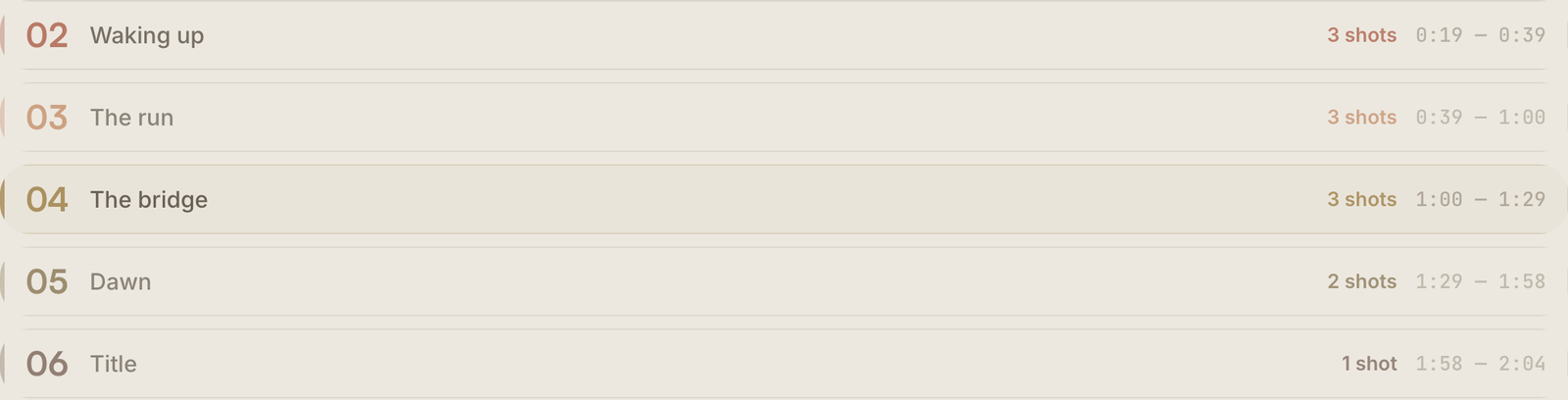
3. Give every section a job
A trip has natural chapters, and they map onto a song almost on their own:
- The quiet opening — arriving, the place before anyone is awake, details. No movement yet.
- The build — getting around: roads, streets, the walk up.
- The peak — the reason you went. The widest, brightest, most alive thing you'll shoot.
- The turn — people, food, small moments. The part you remember later.
- The way out — last light, packing up, one look back.
Write one line per section saying what it is for. That line is what you'll read at 7 a.m. when you can't decide whether to get out of bed for the sunrise.
4. Count the shots — this is the step that saves the trip
Here is the arithmetic nobody does, and the reason I overshot in Luxembourg:
Shots a section needs = its length ÷ how long each shot stays on screen.
A calm 20-second opening with 5-second shots needs 4 shots. A 20-second chorus cut every 2 seconds needs 10. A whole three-minute song rarely needs more than 50 to 70 shots.
Fifty to seventy. Not four days of footage. Once you see the number, two things change: you stop filming everything "just in case", and you start caring about which fifty.
Add a margin — shoot two options for each one — and you are still carrying home a hundred and something clips, each of which has a place to go.
5. Write the shots against the seconds
Now fill each section with the shots it needs. For each one, four things are enough:
- What it is — "the old town from the bridge, wide, static".
- How long it's on screen — so the section adds up.
- Which camera — I travel with a Sony a7 II and a Tamron 20–40mm, an action camera, a 360 camera and my phone. Deciding in advance what goes on which one is the difference between swapping gear all day and knowing that the 360 only comes out for the peak.
- When — golden hour shots have a window. If three of them belong to the same evening in three different places, you want to find out now, not there.
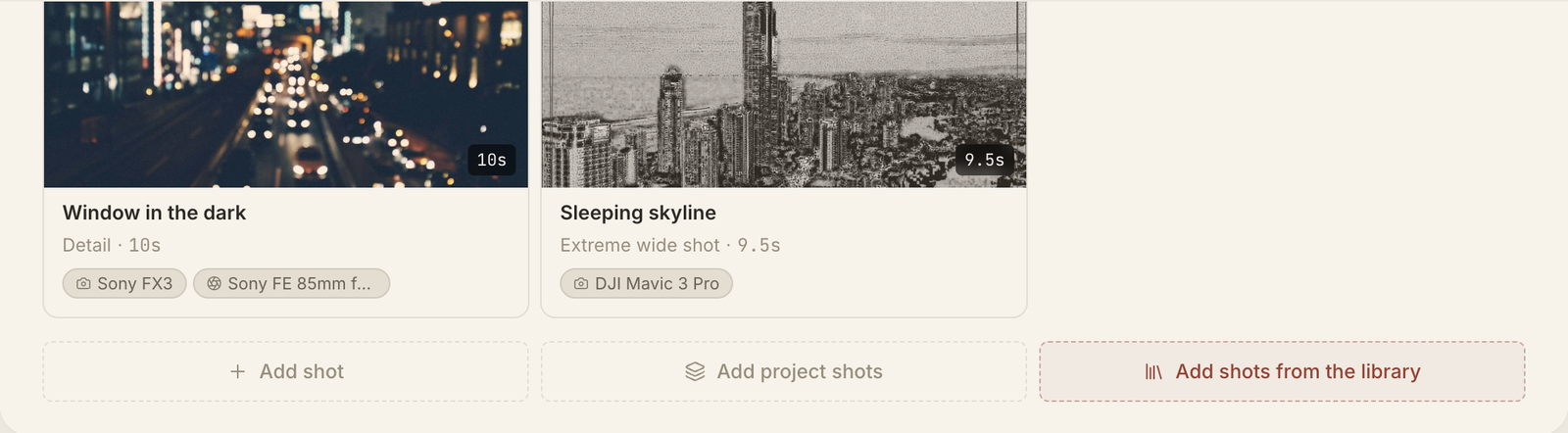
6. Look for the holes before you leave
Add up the shots in each section and compare with the section's length. Wherever the shots don't reach, you have uncovered time: seconds of song with nothing to put on them. Finding that at home, a week before the trip, costs nothing. Finding it in the edit costs the opening of your film.
This is the check I never did. With no plan, I had no way of knowing which parts of the song were covered five times over and which had nothing.
7. On location: the list first, then play
Shoot what's on the list for that day and that light, tick it off, and then film whatever you like. The list isn't there to make the trip rigid. It is there so that the improvised shots are a bonus instead of the whole plan.
The same method in PreFrame
Everything above works on paper. I built PreFrame because I wanted to do it on the song itself.
You drop the track in and see its waveform. You cut it into sections where you hear the changes, and draw the emotional curve you want the film to follow on top — so the plan shows not just where the song changes, but how intense each part should feel.
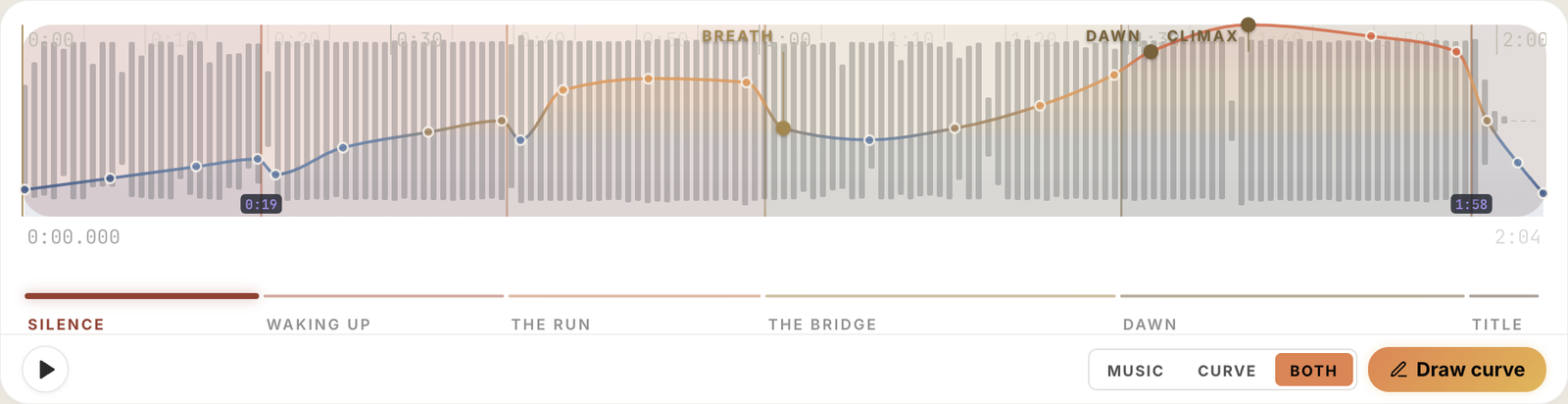
Each shot sits on real seconds inside its section, with its type, camera, lens and notes. The uncovered time is calculated for you. Shots can carry the light for that place and that day, so you know before you travel whether the golden-hour shot is even possible.
References — frames, videos, a palette, notes — live on a board next to the timeline and filter by section, so when you open "the peak" you see what you wanted it to look like.
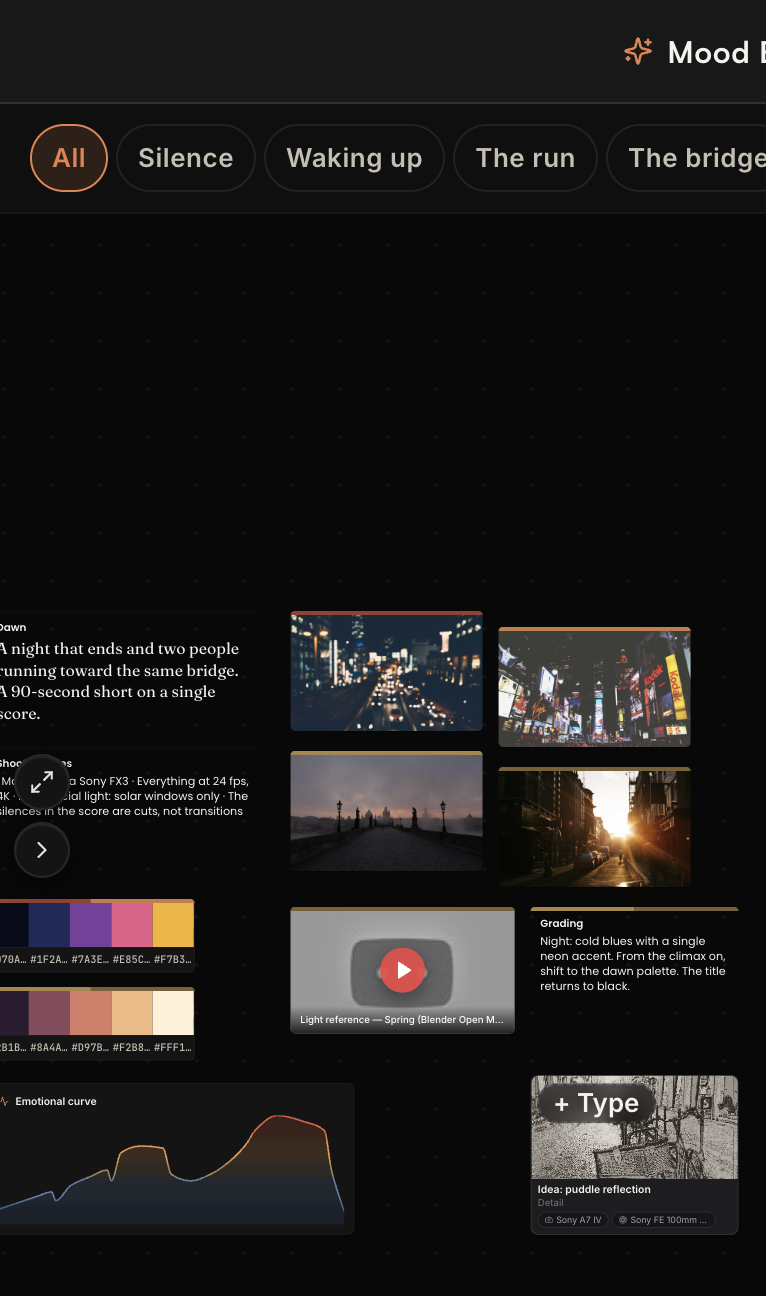
When you're done you export two things: a printable shooting plan with every shot, its timecode and a box to tick — and the sections as markers for your editor, so the edit starts with the song's shape already on the timeline. That second part has its own guide: bringing a song's sections into Premiere, DaVinci Resolve or Final Cut.
The trip is still the trip. You just come home with the film.