How to give your video feeling: plan the emotional arc before you shoot
Feeling isn't added in the edit with slow motion and a sad song. It comes from the shape of the video: how intensity rises and falls over its minutes. How to decide what each part should make people feel, and turn that into shots, before you pick up the camera.
Everyone wants their video to make people feel something. Most try to add it at the end: slow motion on the best clip, a song that sounds sad, a fade to black. It rarely works, and when it does it feels borrowed.
The feeling of a video does not come from any one shot. It comes from its shape: how intense it is at the start, where it climbs, where it lets you breathe, where it peaks, how it ends. Editors call that shape the arc. The good news is that you don't need a script, a crew or dialogue to have one. You need to decide it before you shoot.
What an arc is, in one sentence
An arc is a line of how intense the video feels from its first second to its last. Not what happens: how it feels. A travel film, a short about a morning in a city, a two-minute piece for a brand, all have one, whether anyone drew it or not. The ones that work drew it.
Six rules the trade agrees on
Film editors have been writing about this for fifty years, and they agree on more than you'd think.
- Tension and rest take turns. Anything constant stops being noticed: you don't hear the engines on a plane after ten minutes. A video that is intense all the way through is as flat as one that never gets going.
- Contrast does the work. Fast after slow, quiet after loud, a face after a landscape. The change is what the viewer feels, more than either side of it.
- One peak, near the end, with a climb to it. Two equal peaks halve each other. An early peak steals from the end. Decide where the biggest moment is and make everything before it lead there.
- The pause before the hit. Right before the biggest moment, hold. A still shot a second longer than feels comfortable, or a drop in the music. The silence is what makes the hit land.
- Every part has to change something. If a part ends in the same place it started, in feeling, it goes. Walter Murch, who edited Apocalypse Now, gives emotion 51 points out of 100 when he decides a cut; the story gets 23 and the rhythm 10.
- End with an echo of the beginning. The same place, the same shot size, the same light, changed. It tells the viewer the video is over without a title card.
The five parts
Almost every arc divides into the same five parts. Give each one a job and a feeling, and the plan writes itself.
| Part | Its job | It has to feel like | In the example |
|---|---|---|---|
| Hook | Make them stay | Curiosity, calm, a promise | Silence: a city still asleep, one lit window |
| Context | Say where we are and who this is about | Recognition, the first pulse | Waking up: she gets up and leaves |
| Development | Things start to move | Momentum | The run: empty streets, drums come in |
| Climax | The reason the video exists | Everything turns | The bridge: the meeting at first light |
| Resolution | Let go | Release, warmth | Dawn: the sun over the river, a smile |
The example is the two-minute video used across these guides, a city before dawn and someone running through it. Notice that the climax is not the loudest part. The meeting on the bridge is where the story turns; the sun coming up afterwards is where it lets go, and the music is at its biggest there. The peak of feeling and the peak of sound don't have to be the same shot. Deciding which is which is the plan.
Draw it
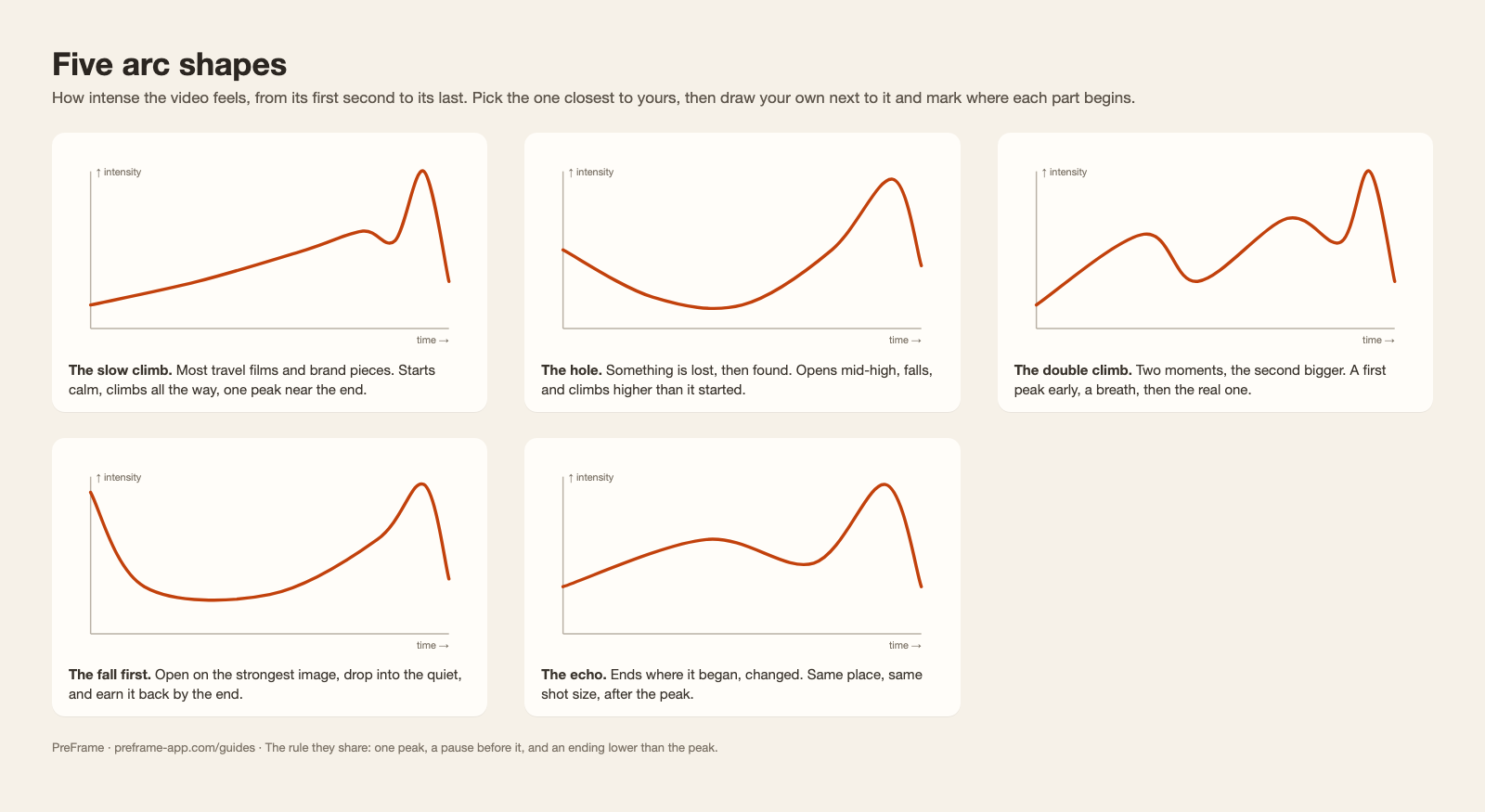
Take a sheet of paper. A horizontal line is the length of the video; the vertical is how intense it feels. Draw the line: it starts low, climbs, dips just before the big moment, peaks, and comes down into the ending. Mark where each of the five parts begins. Then write one line under each part: it must feel like…
That page is worth more than any list of shots, because every shot you plan from now on has to answer to it.
Download the arc shapes. Five shapes that cover most videos, drawn, with when to use each: the slow climb, the hole, the double climb, the fall first, and the echo. arc-shapes.png. Print it and draw yours next to them.
From the arc to shots and seconds
The arc decides how you film each part, before it decides what you film.
| Where the line is | Shots | Seconds per shot |
|---|---|---|
| Low and flat | Still camera, few shots, wide or detail | Long, 8–12 |
| Climbing | Camera starts to move, more shots | Shorter as it climbs, 7 down to 4 |
| The dip before the peak | One shot, still | A second longer than comfortable |
| The peak | Either the shortest cuts of the video, or one held shot | 1–2, or one long hold |
| Coming down | Still again, warm, faces | Long, 10–14 |
In the example that gives the opening two shots of ten seconds, the run three of seven, and the dawn two long holds, the longest of the video, over the loudest music. The guide on editing to the beat has the numbers behind those seconds.
With a song or without one
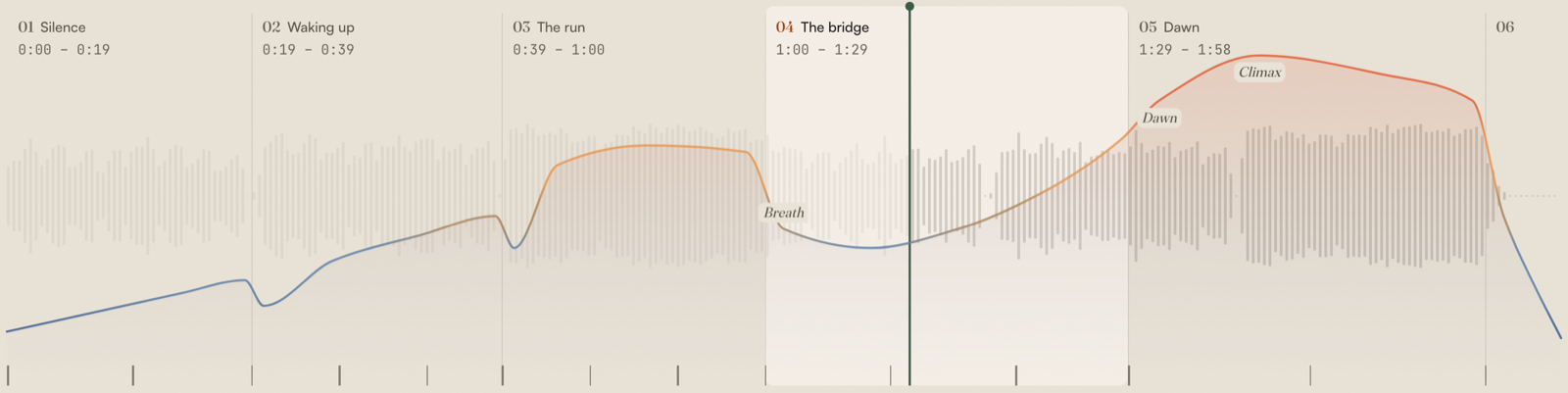
If you already have the song, the arc is in it: where it climbs, where it drops out, where it peaks. Listen for the changes and the parts are the song's sections; this is how to find them. If you don't have the song yet, draw the arc anyway. Half the videos planned this way start without a track, and the emotional curve is the drawing that replaces it until it arrives. When it does, the parts and the shots move onto its seconds and the plan stays.
The same thing in PreFrame
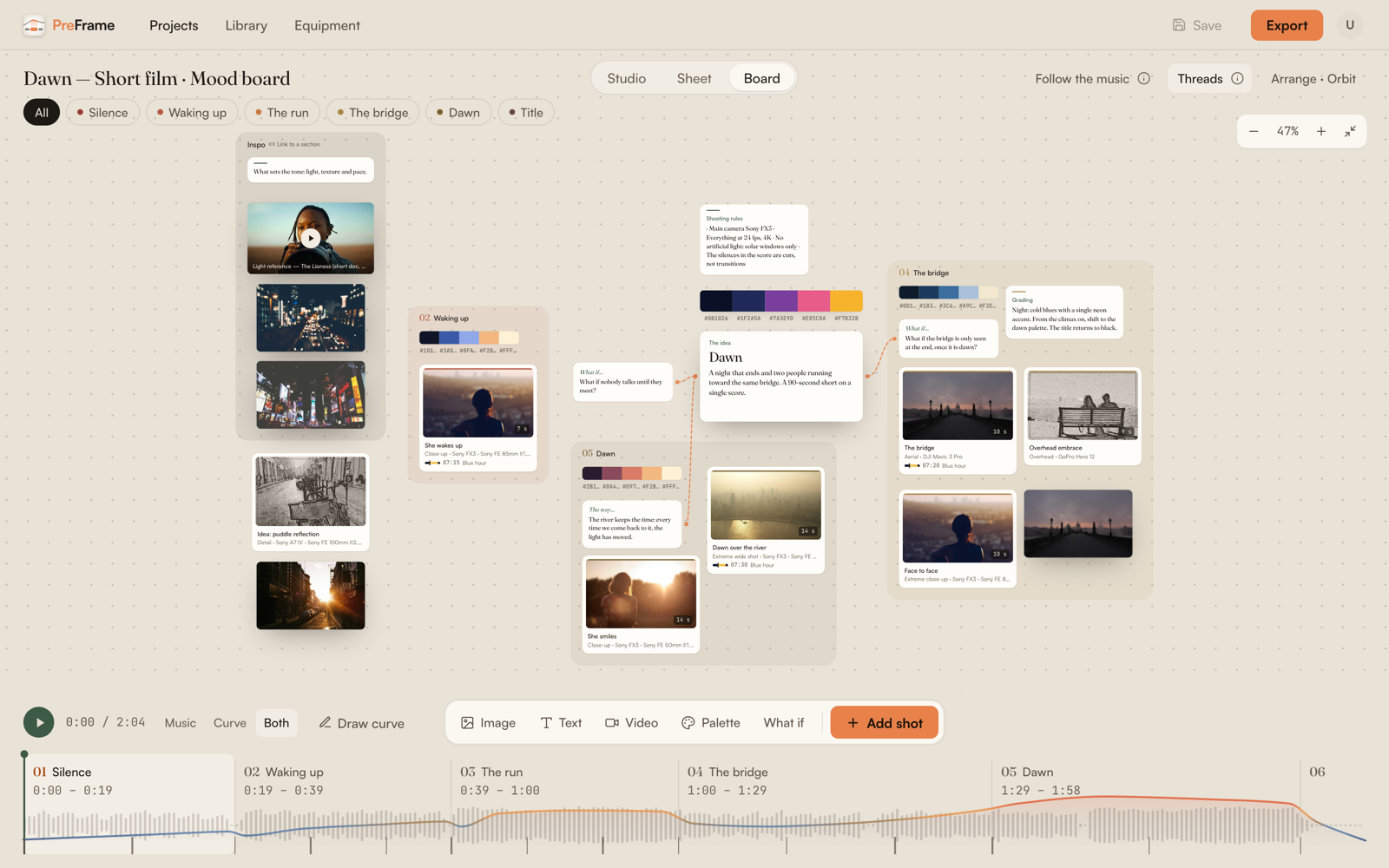
The arc is drawn as the emotional curve over the length of the video, with labels on its peaks and dips, and the video is cut into its parts on that curve, named for the job each one does: hook, context, development, climax, resolution. Each part carries a note of what it must feel like. If the song is already there, the curve is drawn over its waveform and the parts are cut where the music changes.
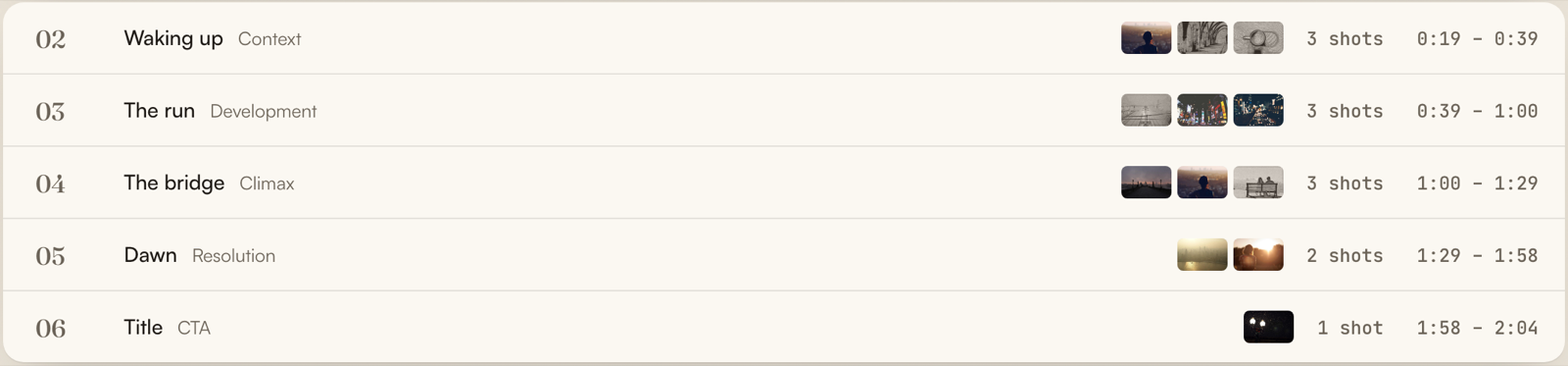
The board holds what each part has to look like: references grouped by part, the idea of the video in the middle, its colours. And every shot inside a part carries its seconds, so the long holds and the short cuts of the table above are decided before the shoot. How the curve, the parts and the board work is explained in support.